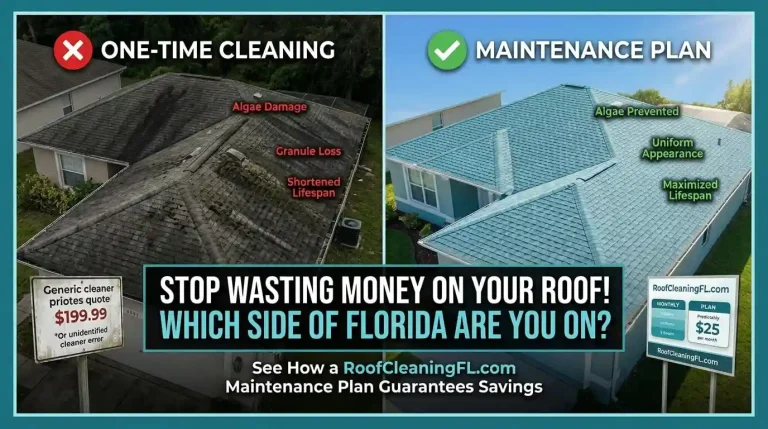
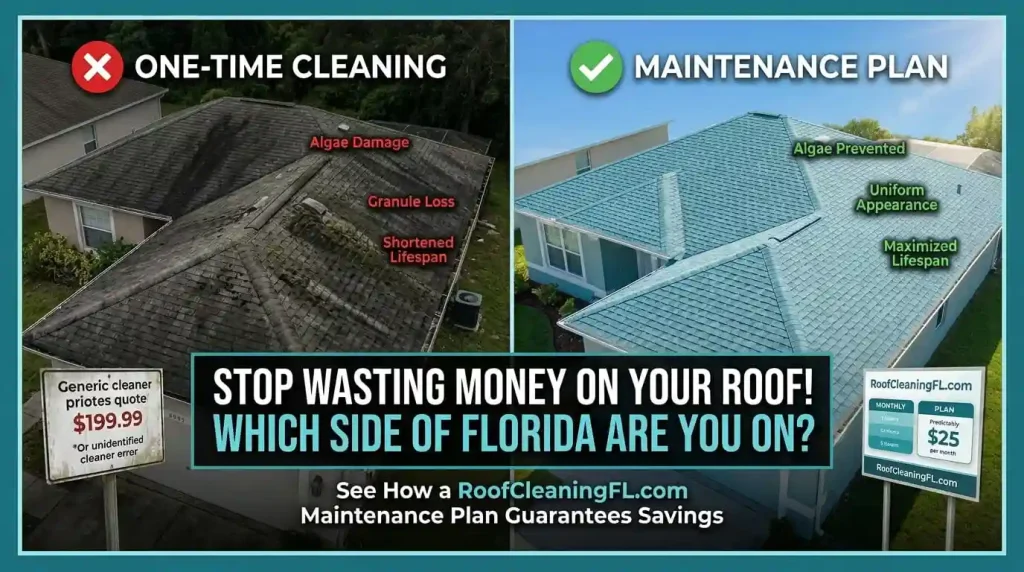
A roof maintenance plan saves significantly more money long-term than repeated one-time cleanings, and the numbers make the case clearly. Fort Lauderdale homeowners who treat roof cleaning as a reactive task rather than a scheduled one end up paying more per cleaning cycle, shortening the life of their roof faster, and exposing themselves to repair bills that dwarf what a structured plan would have cost in the first place.
That said, the full picture is more nuanced than a simple “plan beats one-time” headline. The right answer depends on your roof type, how long you plan to stay in the home, your roof’s current condition, and the specific climate pressures your property faces in Broward County. This post breaks it all down so you can make a financially sound decision rather than just a convenient one.
Why This Comparison Matters More in South Florida Than Anywhere Else
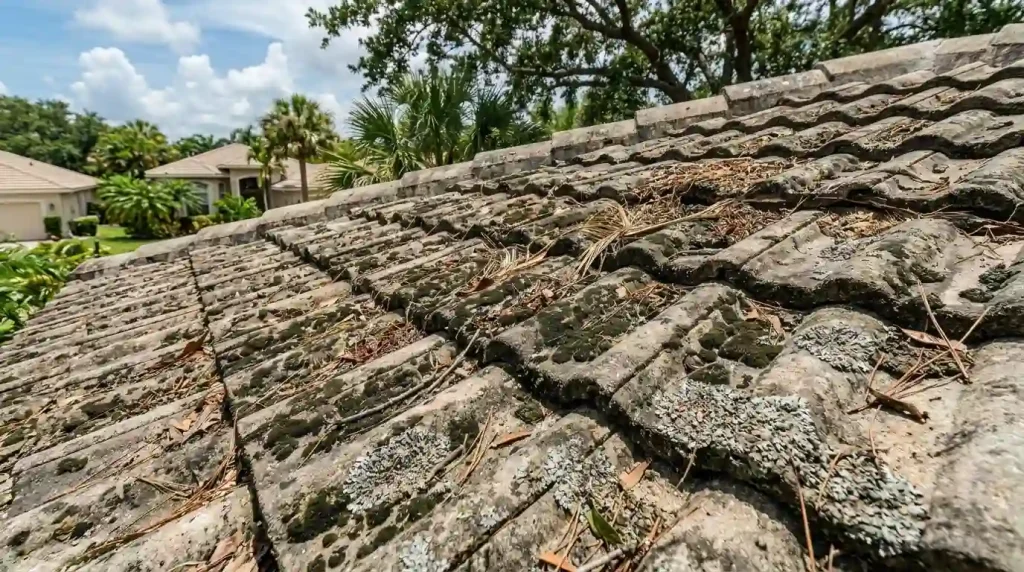
Fort Lauderdale is not a forgiving environment for roofs. The city sees roughly 60 inches of rainfall per year, intense UV exposure, Atlantic salt air, and a hurricane season that runs six months out of twelve. These conditions create year-round biological growth on roofs including Gloeocapsa magma algae, mold colonies, mildew, lichen, and organic debris accumulation from palm fronds and live oak canopy.
What this means practically is that a roof left unattended does not degrade on the same timeline it would in, say, a dry Arizona climate. In Fort Lauderdale, algae can visibly recolonize a professionally cleaned roof within 12 to 18 months under shaded or coastal conditions. Mold and mildew can take hold even faster after storm season. Lichen, which embeds its rhizines into tile and shingle surfaces, can begin forming within two years if no preventative treatment is applied after cleaning.
This is the environmental reality that should frame every cost comparison you make between a one-time cleaning and a structured maintenance approach.
What a One-Time Roof Cleaning Actually Costs in Fort Lauderdale
A professional soft wash roof cleaning for a standard residential home in Fort Lauderdale typically runs between $250 and $700 depending on roof size, pitch, roof type, and the severity of contamination. Heavily algae-covered roofs or larger two-story properties can push that figure to $700 and above.
That cost sounds manageable in isolation. The problem is that one-time cleanings in South Florida’s climate tend to become a recurring expense anyway, just on an unplanned and often more expensive schedule.
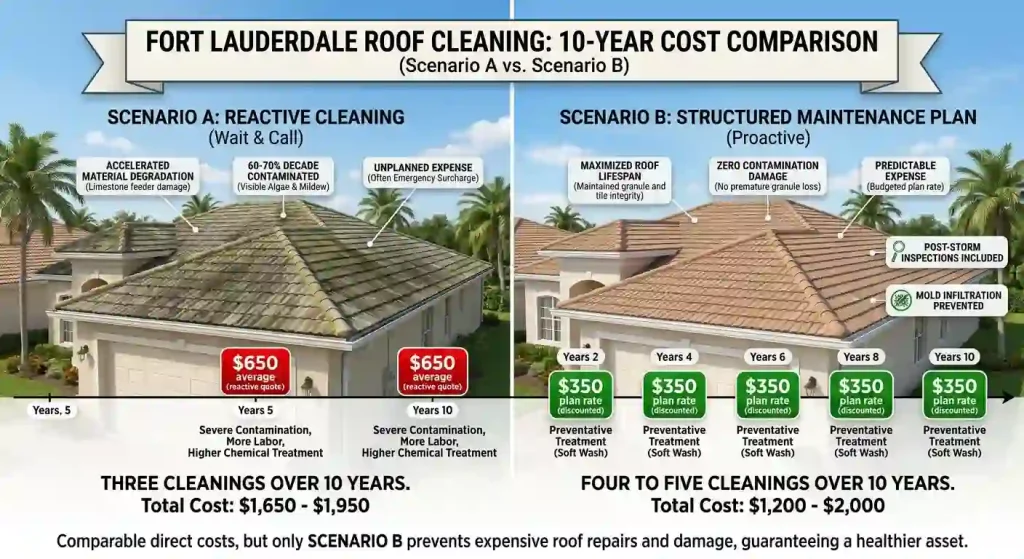
Here is what the cost trajectory looks like for a homeowner who treats cleaning as a call-when-it-looks-bad task over a 10-year period:
Scenario A assumes cleaning is performed once every 4 to 5 years reactively, when staining becomes severe enough to prompt action. At that point the contamination level is significantly worse, which means more chemical treatment, more labor time, and often a higher quote. Three cleanings over 10 years at an average of $550 to $650 each comes to roughly $1,650 to $1,950 in direct cleaning costs. It also means the roof spends 60 to 70 percent of that decade in a contaminated state, which accelerates material degradation.
Scenario B assumes a properly structured maintenance plan with cleanings every 2 years, post-storm inspections included, and a preventative treatment applied after each cleaning. Four to five cleanings over 10 years at a discounted plan rate of $300 to $400 each comes to $1,200 to $2,000 in direct cleaning costs, comparable to the reactive scenario on the surface. The difference emerges in what does not happen: no premature granule loss, no accelerated tile porosity, no mold infiltration into underlayment, no emergency cleaning surcharges, and no repair costs from contamination-related damage.
The Hidden Financial Impact of Skipping Regular Cleaning
The real financial argument for a maintenance plan is not the cost of the cleaning itself. It is everything the cleaning prevents.
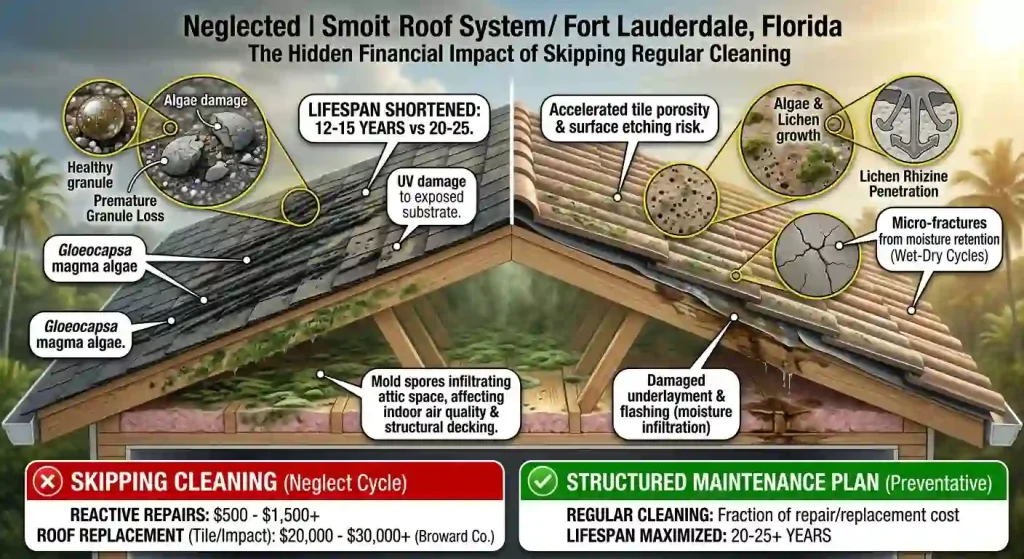
Gloeocapsa magma algae feeds on the limestone filler in asphalt shingles. As it grows, it breaks down the shingle’s protective granule coating, making the surface more porous and more vulnerable to UV damage. The result is premature granule loss, which shortens the effective lifespan of an asphalt shingle roof from a potential 20 to 25 years down to 12 to 15 years under chronic algae exposure without intervention.
Tile roofs face a different but equally serious problem. Algae and lichen growth increases the moisture retention of concrete or clay tiles, and repeated wet-dry cycles cause micro-fractures over time. Lichen in particular is damaging because its rhizines physically penetrate tile surfaces as it anchors itself, and removal at an advanced stage requires more aggressive treatment that can itself cause surface etching if not handled correctly.
Mold and mildew that establish on roof surfaces do not stay there. In Florida’s humid climate, mold spores travel through roof deck penetrations, around flashing points, and into the attic space, where they can affect structural decking and eventually degrade indoor air quality. A roof cleaning that happens every two to three years interrupts this progression before it reaches the deck level.
The cost of roof repair in Fort Lauderdale for issues like damaged underlayment, compromised flashing, or early-stage decking deterioration typically starts around $500 to $1,500 for moderate problems and climbs well above that for anything structural. A full roof replacement in Fort Lauderdale averages between $8,000 and $15,000 for standard residential properties, with tile or impact-rated roofing systems pushing well into the $20,000 to $30,000 range depending on size and Broward County permitting requirements.
Against those numbers, the cost difference between a reactive cleaning strategy and a structured maintenance plan becomes almost irrelevant. The plan pays for itself by preventing even one significant repair event.
What a Roof Maintenance Plan Actually Includes
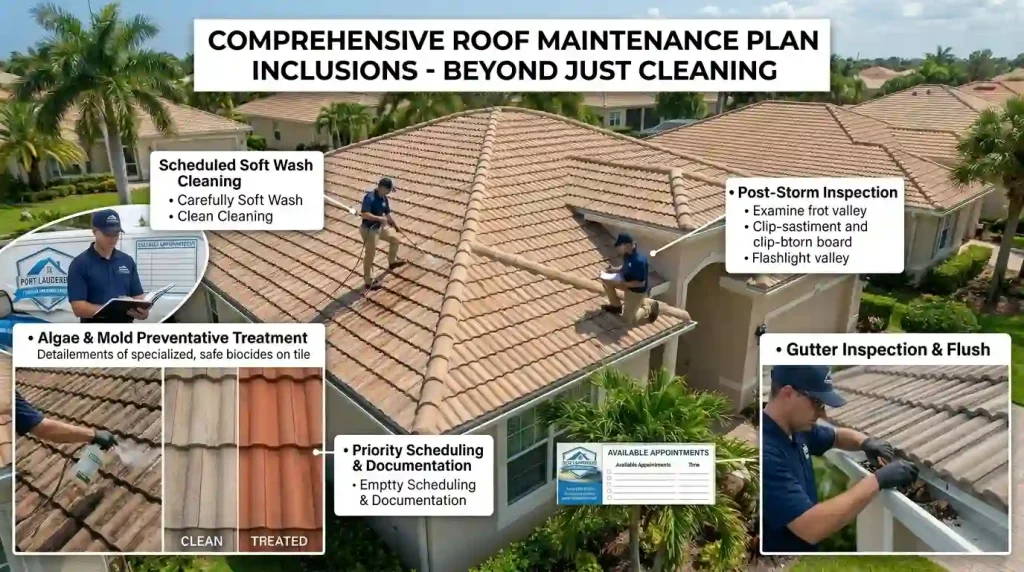
A roof maintenance plan is not simply a prepaid cleaning schedule, and if someone is selling it to you that way, ask more questions. A properly structured plan for a Fort Lauderdale property should include several components beyond the cleaning itself.
Scheduled soft wash roof cleaning on a defined interval, typically every 12 to 24 months depending on roof type and canopy coverage around the property.
Pre and post-storm inspection service, which matters enormously in a market where hurricane season runs from June through November and tropical storms can leave debris, damaged flashing, and shifted underlayment that invites water intrusion.
Algae and mold preventative treatment applied after each cleaning to slow biological regrowth and extend the clean period. Without this step, South Florida’s climate begins to undo a cleaning within months rather than years.
Gutter inspection and flush as part of each service visit, since clogged gutters on Fort Lauderdale properties create backflow conditions that force water under fascia and into roof edges, accelerating rot and mold growth at precisely the points where it is hardest to detect.
Priority scheduling and documentation, meaning your cleaning history is on file, your next service date is already booked, and your roof is never left waiting six months for an available appointment after a storm event.
Who Should Choose a One-Time Cleaning
One-time cleaning is the right call in specific circumstances, and being honest about this matters more than pushing every homeowner toward a plan.
If you are preparing a property for sale and need the roof to present well for a home inspection or appraisal, a single professional soft wash cleaning before listing is appropriate and cost-effective. You are not trying to extend the roof’s life by a decade; you are addressing curb appeal and inspection optics for a transaction with a defined timeline.
If you have recently purchased a home in Fort Lauderdale and the roof is in its first or second year post-replacement with no visible contamination, a one-time cleaning now makes little sense. Wait until the appropriate interval and then transition into a maintenance schedule at that point.
If your roof is at or near end of life and a replacement is already planned within the next one to two years, cleaning it now is a cosmetic decision rather than a financial protection strategy. In that scenario, a one-time service to improve appearance while the replacement is scheduled is sensible. Enrolling in a multi-year plan is not.
The Break-Even Point for a Maintenance Plan
The financial break-even on a roof maintenance plan versus reactive one-time cleanings typically occurs within the first four to six years for a Fort Lauderdale homeowner who plans to stay in the property long-term.
After that break-even point, the maintenance approach begins generating clear savings through:
Extended roof lifespan. Industry data consistently shows that roofs on active maintenance schedules last significantly longer than neglected ones. The difference between a tile roof that reaches 30 years and one replaced at 18 years because of accelerated contamination damage represents tens of thousands of dollars in avoided replacement cost, particularly in South Florida’s high-labor-cost coastal market.
Lower per-service cost. Many professional roof cleaning companies in Fort Lauderdale offer reduced rates for maintenance plan clients compared to first-time or one-off jobs. When a technician is already familiar with your property, roof pitch, and access points, the job takes less time and the relationship is worth protecting on both sides.
Insurance protection. Florida homeowners insurance is already among the most expensive in the country. Some carriers have moved to deny claims or non-renew policies on properties where roof algae and neglect are visible during underwriting inspections. A documented cleaning history is evidence of responsible maintenance that protects your claim position and, in some cases, your coverage eligibility.
Energy cost reduction. Dark algae staining increases heat absorption across your roof surface, which forces your air conditioning system to work harder during Fort Lauderdale’s long summer months. A clean, light-reflecting roof surface reduces cooling load. For a home running AC heavily from April through October, this is not a negligible consideration.
Tile, Shingle, Metal, and Flat Roofs: Does the Answer Change by Roof Type?
The calculus shifts slightly depending on what your roof is made of.
Tile roofs are the most common type in Fort Lauderdale, and they benefit most from consistent maintenance plan cleaning. Tile is porous and traps biological growth beneath and between tiles in ways that become exponentially harder to address the longer contamination is allowed to establish. A maintenance plan on a tile roof delivers the highest long-term value of any roof type in this climate.
Asphalt shingle roofs in South Florida have shorter lifespans than tile or metal to begin with, making maintenance-driven lifespan extension particularly valuable. Every year added to an asphalt shingle roof through proper cleaning reduces the amortized cost of that roof system.
Metal roofs are the most forgiving in terms of biological growth resistance, but they are not immune. Coastal properties in Fort Lauderdale see salt air accelerate rust and corrosion around fasteners and seams, and debris accumulation creates moisture retention points. A less frequent maintenance schedule, perhaps every two to three years, still outperforms reactive cleaning in terms of catching corrosion early.
Flat roofs, common on commercial and modern residential properties in Fort Lauderdale, are arguably the highest-risk category for deferred cleaning. Standing water, mold growth, and debris accumulation on flat surfaces are conditions that worsen very quickly and where an annual maintenance inspection is arguably non-negotiable rather than optional.
The Real Question You Should Be Asking
The one-time versus maintenance plan debate is really a proxy for a more fundamental question: are you treating your roof as an asset to be managed or an expense to be minimized?
A roof in Fort Lauderdale is not a passive structure. It is operating under continuous biological assault from the climate, UV degradation, storm stress, and salt air corrosion. The properties in this market whose roofs last longest and cost the least to own over time are the ones where cleaning and inspection happen on a schedule rather than in response to visible damage.
One-time cleaning resets a clock. A maintenance plan keeps the clock from running against you.
What to Look for When Choosing a Roof Maintenance Plan in Fort Lauderdale
Not every plan offered by cleaning companies in Broward County is equal. Before signing up, verify the following:
The company should be licensed and insured in the state of Florida, with coverage codes appropriate for roof work (codes 5551 and 9041 are industry standard for cleaning operations involving elevated surface access).
The plan should specify the cleaning method in writing. Soft wash using low-pressure application and biodegradable cleaning solutions is the industry-standard safe method for tile, shingle, and metal roofs. Any plan that relies on high-pressure washing as the primary method is not protecting your roof; it is damaging it on a schedule.
The plan should include a written service record after each visit documenting the condition of the roof, any areas of concern identified, and the products used. This documentation matters for insurance purposes and for any future roof warranty claims.
Post-cleaning preventative treatment should be included or offered as an add-on. In South Florida’s climate, cleaning without a biocide or algae-inhibiting treatment applied afterward shortens the clean window considerably.
The Bottom Line
For most Fort Lauderdale homeowners who plan to stay in their home for more than three to four years, a roof maintenance plan is the financially superior choice over repeated one-time cleanings. The savings come not from the difference in cleaning cost but from the damage, repairs, shortened lifespan, and insurance exposure that consistent maintenance prevents.
One-time cleaning has its place for specific situations: pre-sale preparation, newly replaced roofs, or properties near end of their roofing lifespan. Outside those scenarios, treating roof cleaning as a scheduled maintenance function rather than a reactive emergency task is the single most cost-effective decision a Fort Lauderdale homeowner can make for their roof.
If you are ready to stop cleaning reactively and start protecting your roof with a plan built for South Florida’s climate, the team at Roof Cleaning Fort Lauderdale is ready to walk you through your options and give you a free estimate based on your specific roof type and property.